01
What changes first
- Acceleration reserve
- Joining faster traffic
- Passenger performance
What the specs
don't tell you.
A change of scale
By , Editor at MotoUnpacked
Published 31-07-2026 Updated 31-07-2026
What the bigger enginechanges in real life.
More power is obvious. The harder question is what that power changes during an ordinary day—and what the larger scooter quietly makes worse.
Based on 44 official documents, professional reviews, technical references and owner discussions. No MotoUnpacked road test.
Same family look. Different real-world character.
The SH300i adds 32.1 kg and 98 mm of wheelbase—and that changes how both scooters live.
Illustrative render based on 2019 model references. Not a MotoUnpacked road test.
The fast answer
01
02
03
00 / Research chapter
The SH125i is the easier object. The SH300i is the easier vehicle.
The SH125i is lighter to push, cheaper to feed and already fast enough to make dense city travel feel effortless. It asks very little of its rider and of the space around it.
The SH300i asks more in the garage, but less when the road opens. It accelerates with far more reserve, carries additional weight more convincingly and makes faster routes feel normal rather than negotiable.
The upgrade is not slow scooter to fast scooter. It is closer to a scooter that solves the city becoming one that also solves the roads around it.
The correct scooter is the one whose disadvantages occur least often in your actual week.
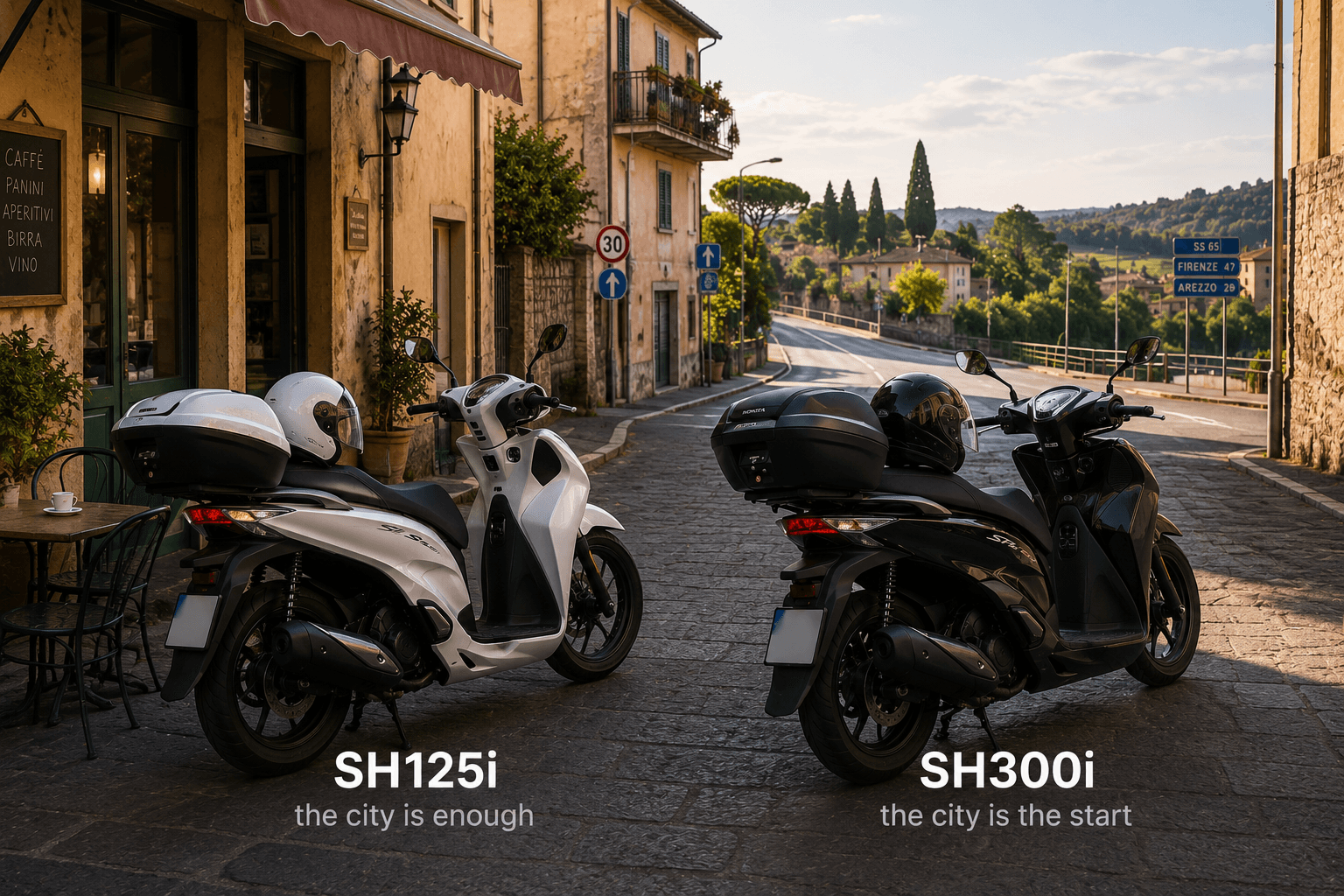
The same step-through idea can serve two different maps: the 125 as a complete city tool, the 300 as an invitation to make the roads beyond it routine. Illustrative render, not a MotoUnpacked road test.
Technical delta
SH125i
124.9 cc
SH300i
279.1 cc
Why it matters
The difference is not simply capacity. It creates a different amount of performance reserve when speed and load rise.
SH125i
8.98 kW
SH300i
18.5 kW
Why it matters
The 300 has 2.06 times the rated output, but the value depends on road, load and overtaking context.
SH125i
11.5 Nm
SH300i
25.5 Nm
Why it matters
The extra torque is most useful when recovering speed, climbing or carrying a passenger.
SH125i
136.9 kg
SH300i
169 kg
Why it matters
The 32.1 kg increase matters most at walking speed; once moving, it can contribute to composure.
SH125i
1,340 mm
SH300i
1,438 mm
Why it matters
The longer 300 supports a broader, calmer road character without changing the SH’s basic step-through format.
SH125i
47.4 km/L · 2.11 L/100 km
SH300i
33.3 km/L · 3.00 L/100 km
Why it matters
On Honda’s standardised basis, the 300 uses roughly 42% more fuel per 100 km.
Road scenario
The first difference may arrive before the engine starts.
Honda lists the SH300i 32.1 kg heavier than the SH125i. Owners repeatedly describe the smaller SH as low effort; those individual reports align with the official mass difference.
The SH300i remains narrow and its seat is only 6 mm higher, but a leaning scooter makes extra mass feel like urgency rather than a percentage.
Limitation: Rider strength, footing, gradient, storage layout and confidence can outweigh a generation-level conclusion.
At walking speed: clear SH125i advantage.
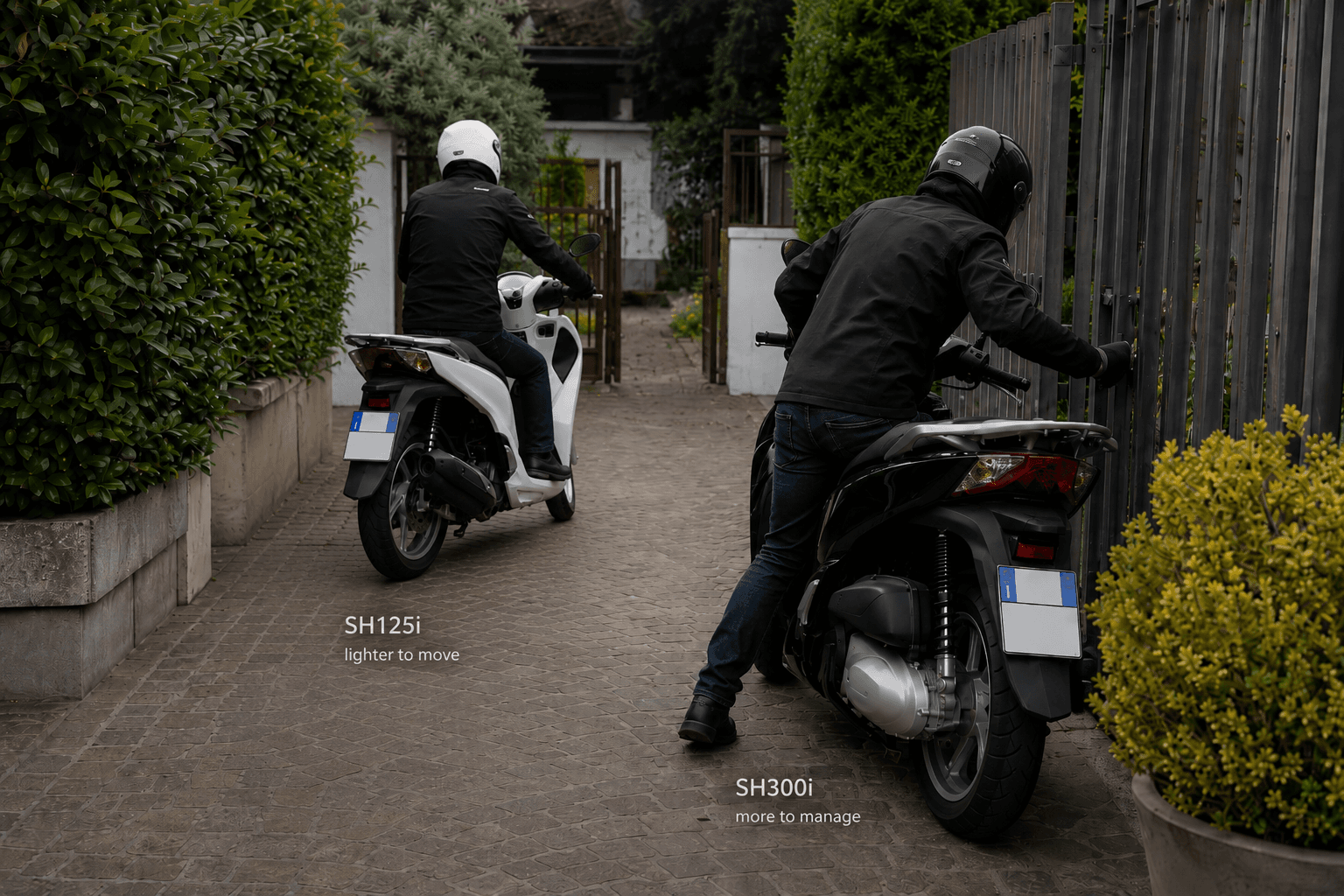
At walking speed, the mass difference becomes a physical and practical question rather than a number in a table. Illustrative render, not a measured handling test.
02 / Research chapter
Its greatest city skill is disappearance.
A specification comparison can make the SH125i look like the machine you tolerate until the SH300i becomes available. That misunderstands it. Honda designed the smaller SH for repeated starts, short openings, narrow gaps, moderate speeds and constant changes of direction.
Its low-to-mid-range calibration, 16-inch wheels, narrow body, upright position and 136.9 kg mass serve that mission. Owner reports commonly describe it as lively to roughly 40 mph, easy to place and inexpensive to use without thinking about fuel. In one detailed UKGSer commuter report, an SH125i rider described comfortable traffic flow and a preferred 50–60 mph range, but that remains an individual account, not a measured limit.
The SH300i remains unusually agile for its capacity. Professional reviews praise its low-speed stability, narrowness and ability to cut through traffic without feeling like a long, heavy maxi-scooter. The difference is that the 125 feels easy because it is light and sufficient; the 300 feels easy because it has reserve and control.
At 30 km/h, those qualities may be equally useful. At 80 km/h, they are not.
For a journey made almost entirely inside a dense centre, the SH125i may be the more satisfying tool.
04 / Research chapter
The larger SH raises the floor beneath the rider’s confidence.
A 125 can travel farther than many riders expect, but not every journey is equally relaxed. A scooter can hold a speed while still requiring too much throttle, patience, advance planning and tolerance for wind or slow recovery after losing momentum.
The SH300i changes the map. A 90 km/h section becomes part of the commute rather than the part you prepare for. A hill becomes a gradient rather than a performance test; a passenger becomes an additional load rather than a new category of journey.
Same-generation professional reviews describe the SH300i as capable on faster roads without losing its city agility. ScooterLab emphasized its acceleration reserve, handling and all-round usability; longer journeys still expose the SH format’s limited wind protection and storage.
The SH300i becomes compelling when faster roads are a recurring part of the week.
Road scenario
The meaningful difference is performance margin, not an argument about top speed.
Honda’s technical documentation gives the 300 more than twice the 125’s rated power and torque. ScooterLab reported strong acceleration and broader-road ability from the same SH300i generation; one owner who moved from an SH125i to an SH300i described the larger scooter as resolving the 125’s faster-road limitation.
The SH125i asks whether an opening is large enough. The SH300i more often asks whether the manoeuvre is sensible.
Limitation: No clean same-publication, same-method acceleration test for these exact 2019 models was found. This is not a stopwatch claim.
The SH300i makes more roads feel routine, not merely faster.
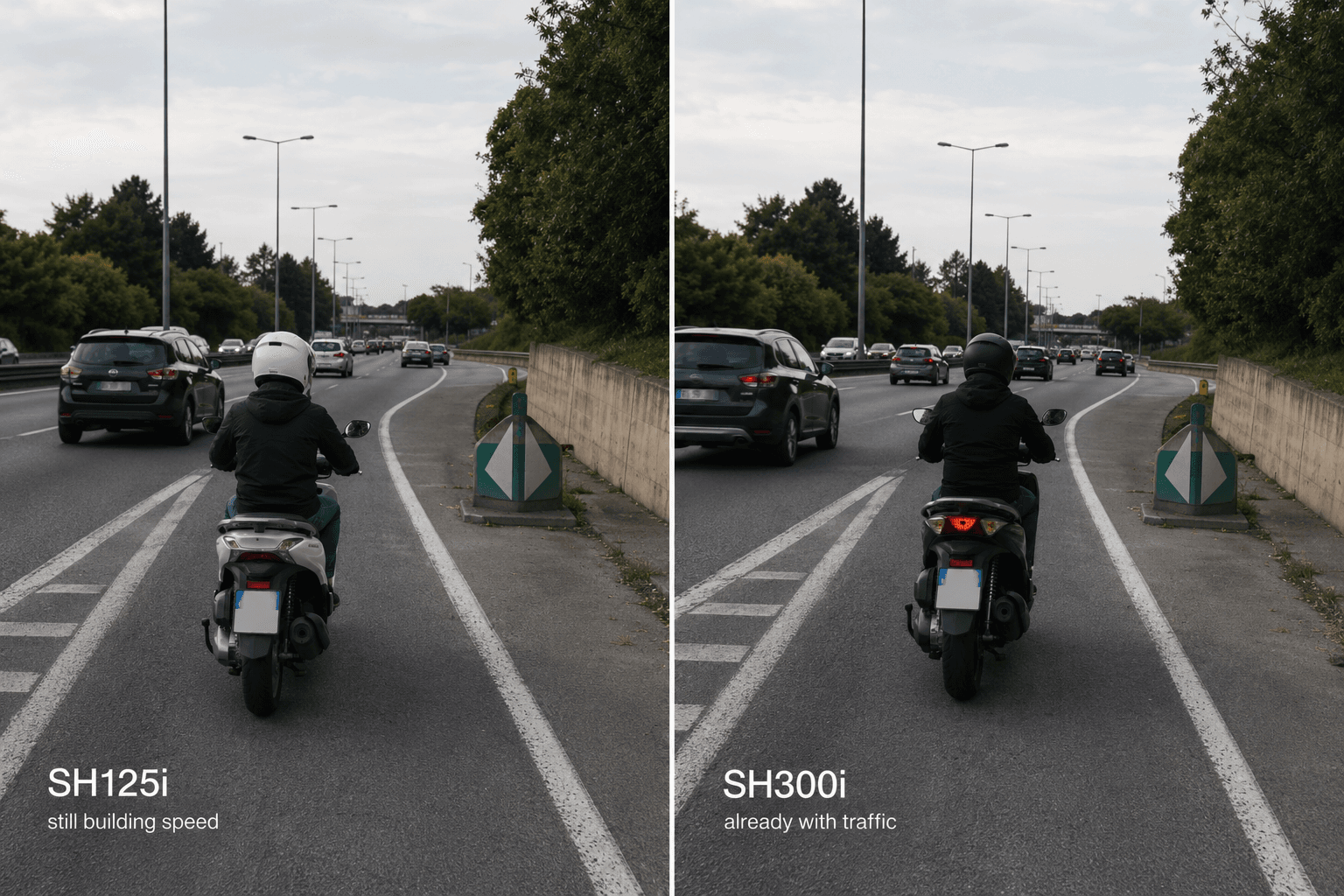
The article examines performance margin on ordinary faster roads, not top-speed theatre. Illustrative render, not a timed acceleration test.
Road scenario
Load makes the specification gap personal.
Both are two-seaters. Honda’s documentation gives the 300 more than twice the power and torque, larger 256 mm discs and a longer wheelbase; Honest John’s same-generation review also reported strong performance and road composure, though not in a controlled two-up comparison.
The 125 can carry someone across town. The 300 is more likely to retain its normal personality while doing so.
Limitation: There is far more two-up reporting for the SH300i than direct back-to-back pillion comparison. Test with the actual passenger.
Regular two-up mixed-road use: the SH300i has the much stronger case.
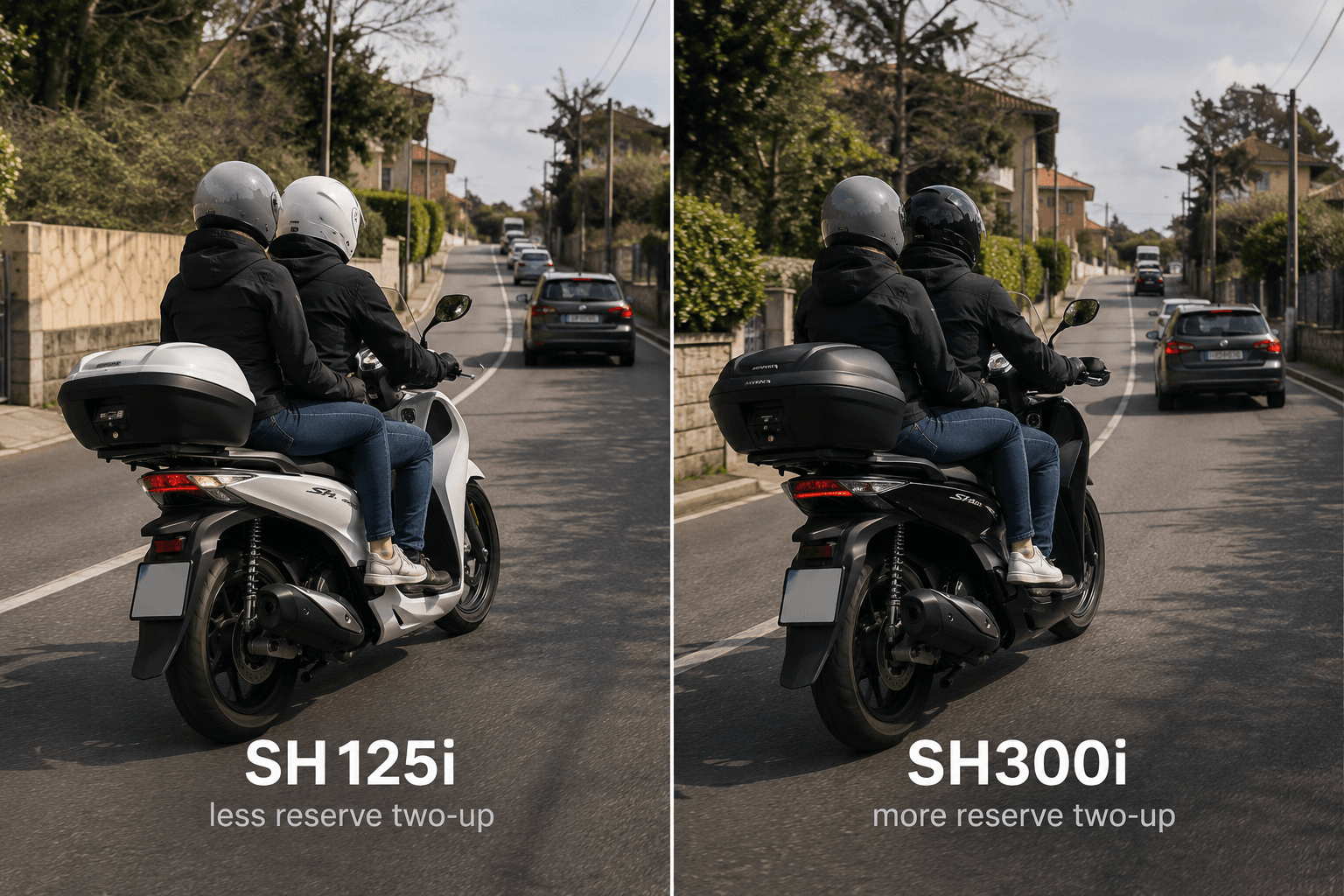
Passenger use makes the output, braking and composure difference personal. Illustrative render, not a measured two-up test.
05 / Research chapter
This is not good brakes versus bad brakes.
The 2019 SH125i already used front and rear 240 mm discs, two-channel ABS, a three-piston front caliper and a single-piston rear caliper. The SH300i used 256 mm discs front and rear, two-channel ABS, a two-piston front caliper, a single-piston rear caliper and HSTC for 2019.
Disc diameter alone does not predict stopping distance. Tyres, surface, ABS calibration, load, brake condition and weight transfer matter—and the SH300i also has more mass to stop.
Motorionline’s SH125i test and Visordown’s same-generation SH300i road test both described reassuring brake behaviour. Neither supplies the controlled exact-model comparison needed for a stopping-distance claim.
For ordinary low-speed city riding, the SH125i is already substantial. The 300’s advantage grows with speed, load and poor conditions.
06 / Research chapter
The SH125i is easier to move. The SH300i is harder to disturb.
At rest, mass is work. At speed, mass can become calm. The SH300i is 32.1 kg heavier and 98 mm longer between the axles, with wider tyres, a stronger fork and a chassis developed for agility with higher-speed composure.
Professional testing repeatedly describes the SH300i as unusually nimble at low speed and stable when the road opens. The SH125i uses lower mass differently: it is easier to redirect, balance during repeated stops and correct after a parking misjudgment.
These are editorial interpretations supported by geometry, mass and recurring reviews—not measurements from a controlled MotoUnpacked test.
07 / Research chapter
Performance can be researched at a distance. Ergonomics cannot.
Several owner discussions pointed in opposite directions. Some riders praised the larger scooter’s upright position, roomy stepped seat and ability to cover serious distance; one former SH300i rider called its seat the worst they had experienced and preferred returning to an SH125, while another liked its performance but could not stretch their legs enough for complete comfort.
Seat height changes by only 6 mm—799 mm versus 805 mm—but seat shape, width, firmness, foot placement and the relationship among hips, knees and bars can matter more than that figure.
A tall rider may dislike fixed foot position. A shorter rider may find the 300 manageable while seated but intimidating when reversing on a slope. Those are not contradictions to smooth away; they are why a personal sit and ride matters.
Do not upgrade for comfort without riding the exact scooter.
08 / Research chapter
A top box changes both scooters more than the engine-size difference does.
The 16-inch rear wheel consumes space that a small-wheeled scooter might use for a deep compartment. Both SHs preserve a flat floor and narrow proportions, but neither becomes a storage-heavy maxi-scooter simply because the engine grows.
Honda said both could accommodate a full-face helmet and offered practical details such as a glove box, bag hook, rear carrier and—in the SH300i’s case—an optional 35-litre Smart Key top box. Helmet shape and market configuration still affect what fits.
Professional and owner reports are less generous than brochure language, especially for the 300. Reviewers repeatedly treated a top box as necessary for serious commuting or touring; an SH125i commuter described under-seat storage plus a top box carrying work and gym equipment while keeping it dry.
Do not choose the SH300i expecting maxi-scooter storage. Budget for a top box on either if it must replace car journeys.
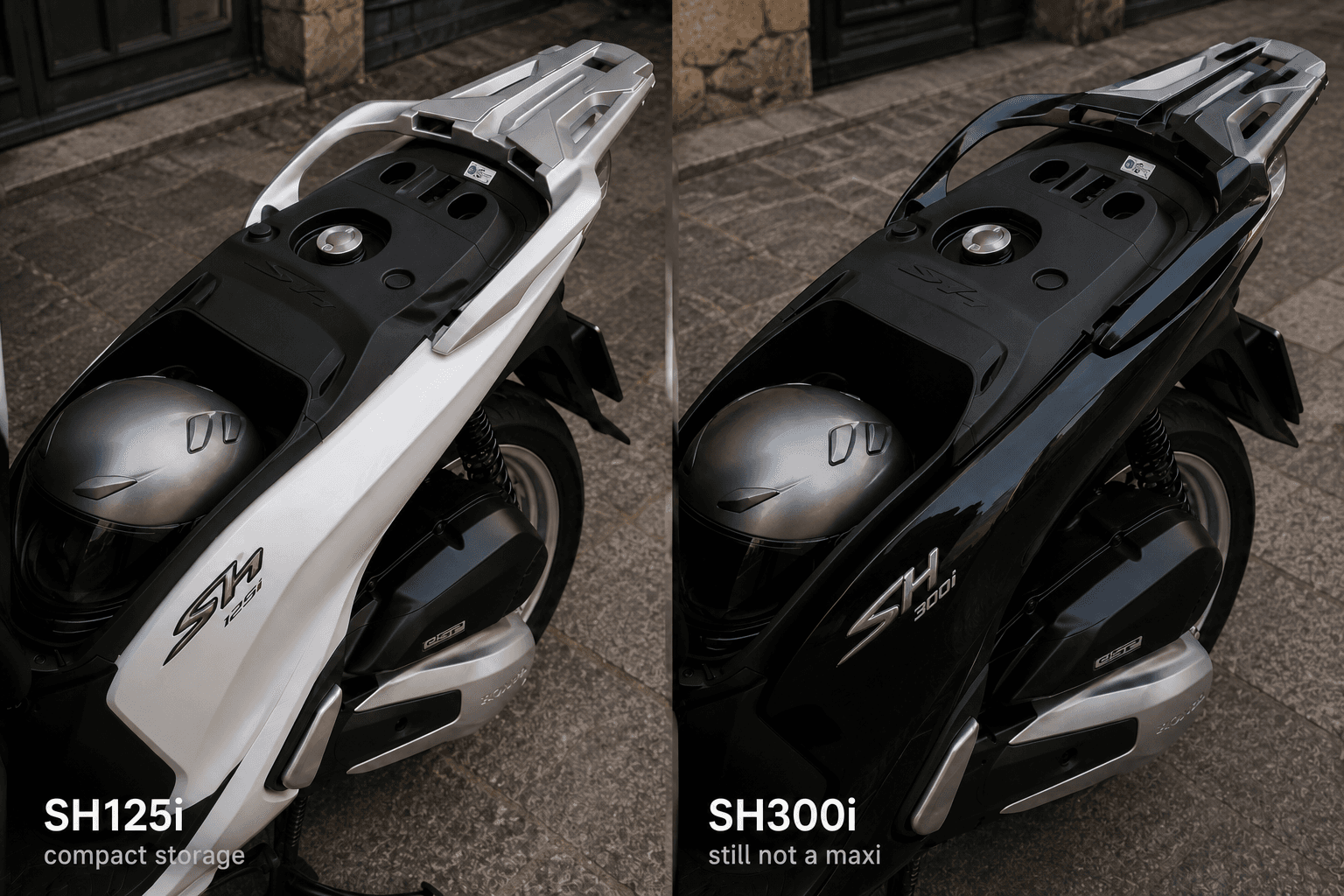
Moving to the SH300i expands the road, not necessarily the luggage compartment.
Illustrative render based on 2019 model references.
09 / Research chapter
The larger scooter earns its consumption only when the rider regularly uses the ability that consumes it.
Honda’s WMTC figures are approximately 2.11 L/100 km for the SH125i and 3.00 L/100 km for the SH300i. On that standardised basis, the 300 uses roughly 42% more fuel per 100 km. Its 9-litre tank partly offsets this against the 125’s 7.5-litre tank.
Real reports vary. An SH125i commuter claimed more than 100 imperial mpg; Motorionline recorded roughly 2.7 L/100 km during fairly aggressive riding. SH300i reviewers reported economical everyday use but heavier consumption at motorway pace. Screens, top boxes, load, traffic and temperature matter.
Fuel is only one ownership cost. Tyres, insurance or tax, purchase price, service fluids and wear items may all differ by country and provider, so the article avoids a pretend universal monthly cost.
If the 125 already completes the route comfortably, its economy is difficult to argue against.
10 / Research chapter
A used 2019 scooter can have several owners, outdoor years and incomplete maintenance.
Both belong to an established Honda family with conventional liquid-cooled single-cylinder engines and automatic V-belt transmissions. That is reassuring. It is not an inspection.
Service history can matter more than displacement. Check cold starting, fluids and leaks, tyre age, discs and calipers, steering and wheel bearings, CVT noise, fork seals, rear shocks, Smart Key functions, centre-stand condition and records for belts, rollers, valves, fluids and tyres.
For the 300, pay particular attention to rear tyre and brake wear, high-speed use, luggage mounts and transmission service. For the 125, look for evidence of full-throttle commuting without care, neglected transmission components, heavily used urban brakes and parking damage. Do not import reliability claims from unrelated older generations.
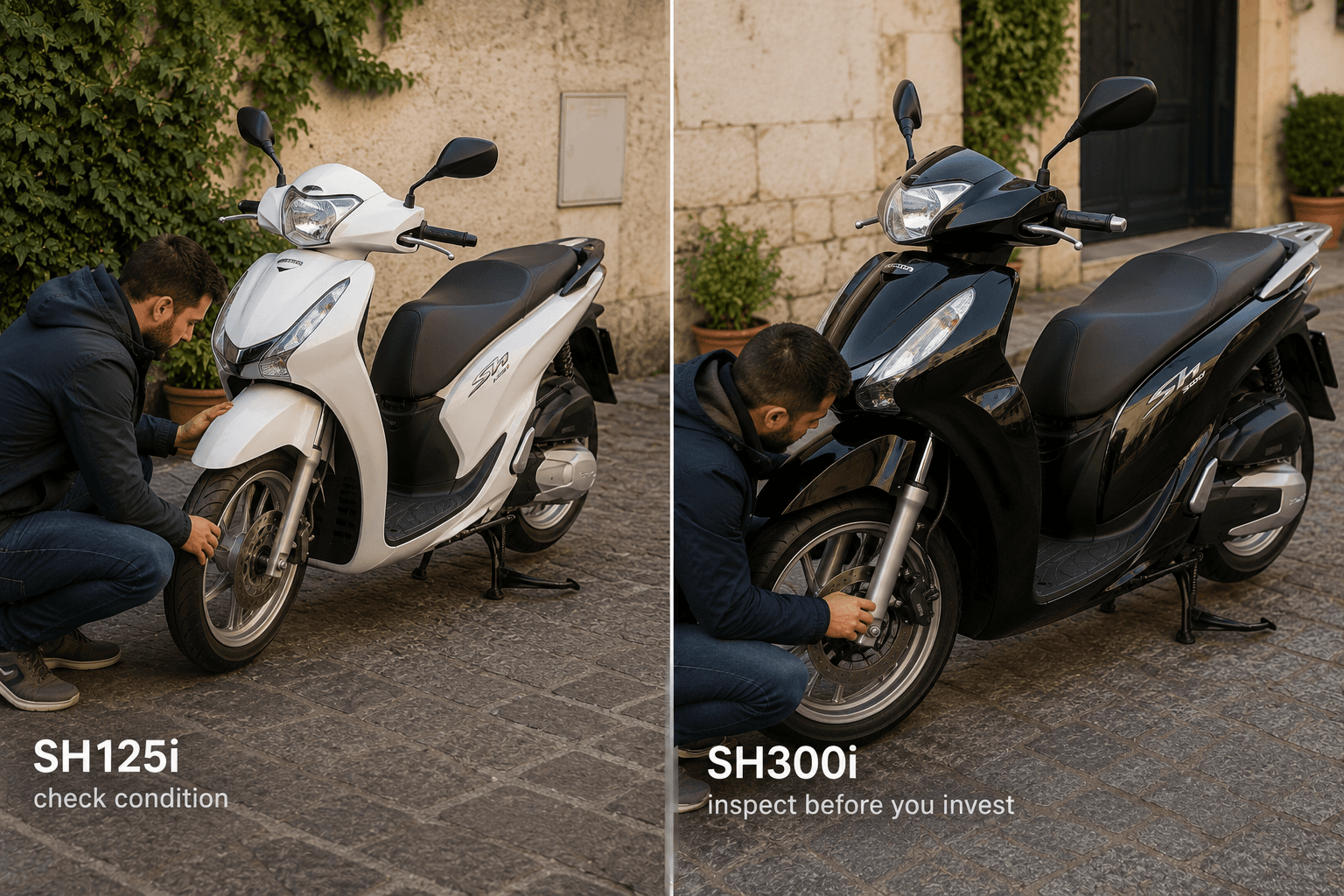
Condition matters more than displacement.
Illustrative render inspired by common pre-purchase inspection practices.
Five riders, five different answers
01
4–8 km, mostly below 60 km/h, frequent filtering and parking, difficult storage.
Keep or choose the SH125i. The 300 adds ability the route rarely requests while making parking more physical and fuel use higher.
02
15–30 km each way, city plus 70–100 km/h roads, hills, exposed sections and occasional overtaking.
The SH300i has a strong case. Performance margin becomes reduced daily effort.
03
Two adults, mixed roads, shopping or luggage, repeated starts and stops.
Choose the SH300i unless trips are very short and slow.
04
Steep ramp, narrow gate, uneven surface, frequent reversing.
The SH125i may be better even when the 300 suits the road. Anxiety before every ride is not an upgrade.
05
The route does not require the 300, but stronger acceleration and flexibility are desirable.
That is valid if the enjoyment occurs often enough to outweigh the extra mass and cost.
Research synthesis · not a measured MotoUnpacked road test
The test ride that will actually answer the question
Do not spend the whole dealer loop enjoying acceleration. Notice whether the 125 feels inadequate or merely busy, and whether the 300 feels reassuring or simply unnecessary.
Which scooter removed a problem I genuinely experience?
The verdict
The SH300i is not simply an SH125i with more engine. It changes where the scooter feels at home.
The SH125i is at its best when the day is dense: close destinations, narrow gaps, repeated stops, constrained parking, modest speeds and low ownership friction. The SH300i is at its best when the day expands: faster roads, longer distances, passengers, hills, wind, overtaking and journeys that no longer fit comfortably inside a 125’s performance envelope.
The SH125i makes the scooter disappear in the city. The SH300i makes more roads disappear as obstacles.
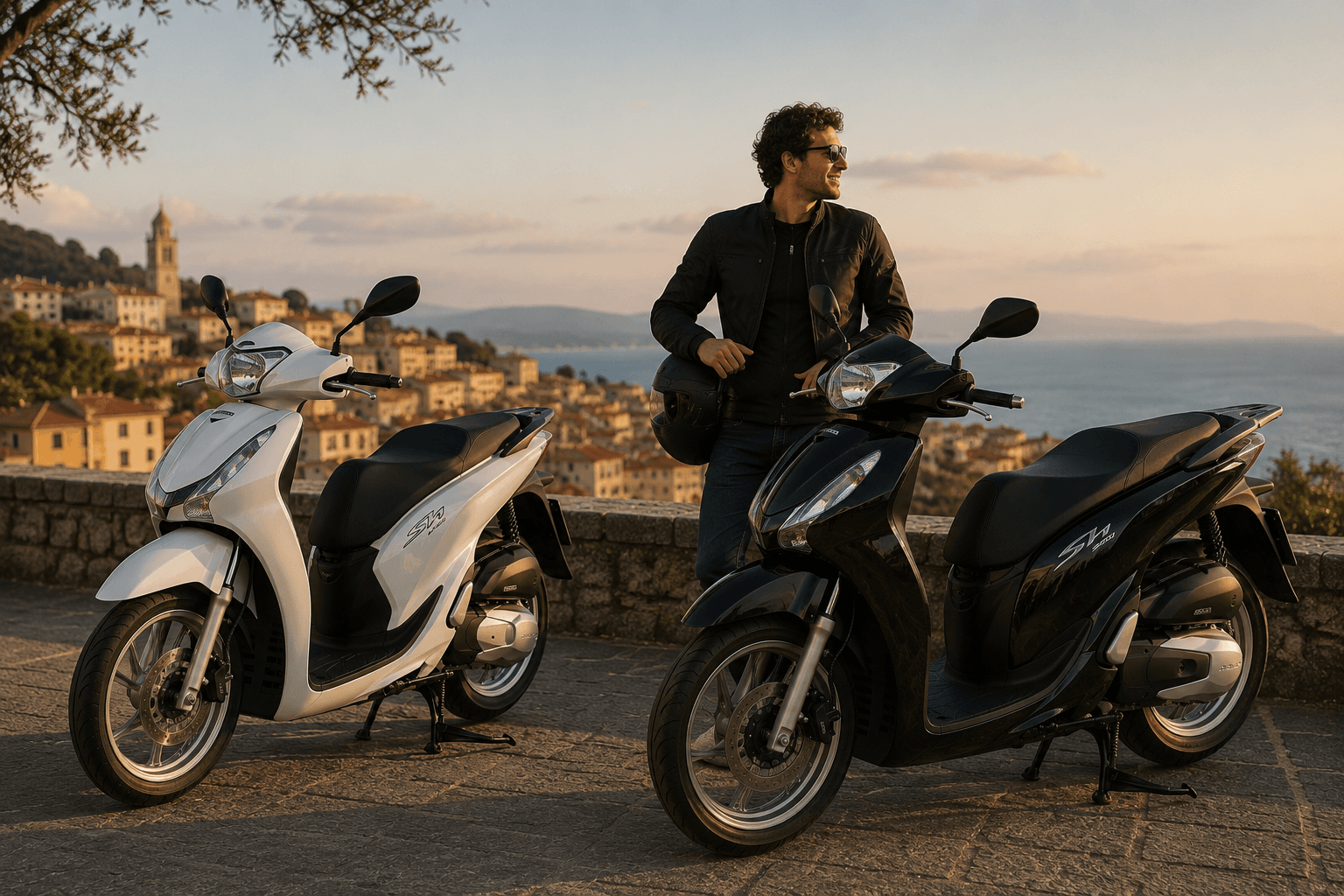
Both scooters speak the same language. The question is simply how far you expect the day to take you.
Illustrative render reflecting the character of both scooters.
Confidence
01
02
03
Research at a glance
Official documents establish the scooters. Independent tests describe how they behave. Owner discussions add day-to-day context. The full bibliography keeps every link and source type visible.
7
Official documents
16
Professional reviews and tests
16
Owner reports and discussions
5
Technical references
Publication record
MotoUnpacked did not road-test the scooters discussed in this article. The comparison is based on manufacturer documentation, professional reviews and owner reports. No manufacturer reviewed or approved the article before publication.
Found an error or a broken source? Contact jacob.slake@motounpacked.com. Material corrections are recorded with the article’s update date.
Commercial disclosure: this article contains no affiliate links, sponsorships, supplied products or other commercial relationships.